
US treasury relies on stablecoins to fund short-term debt, but they can’t fix its $28B long-bond problem
Stablecoin demand is becoming consequential in the U.S. government debt market, but the maturity of that demand matters more than the headline total. Washington now has two debt-market stories running at once. The...
Bitcoin 1 Minute
An important story is making waves across the blockchain ecosystem. Stablecoin demand is becoming consequential in the U. government debt market, but the maturity of that demand matters more than the headline total. Washington now has two debt-market stories running at once.
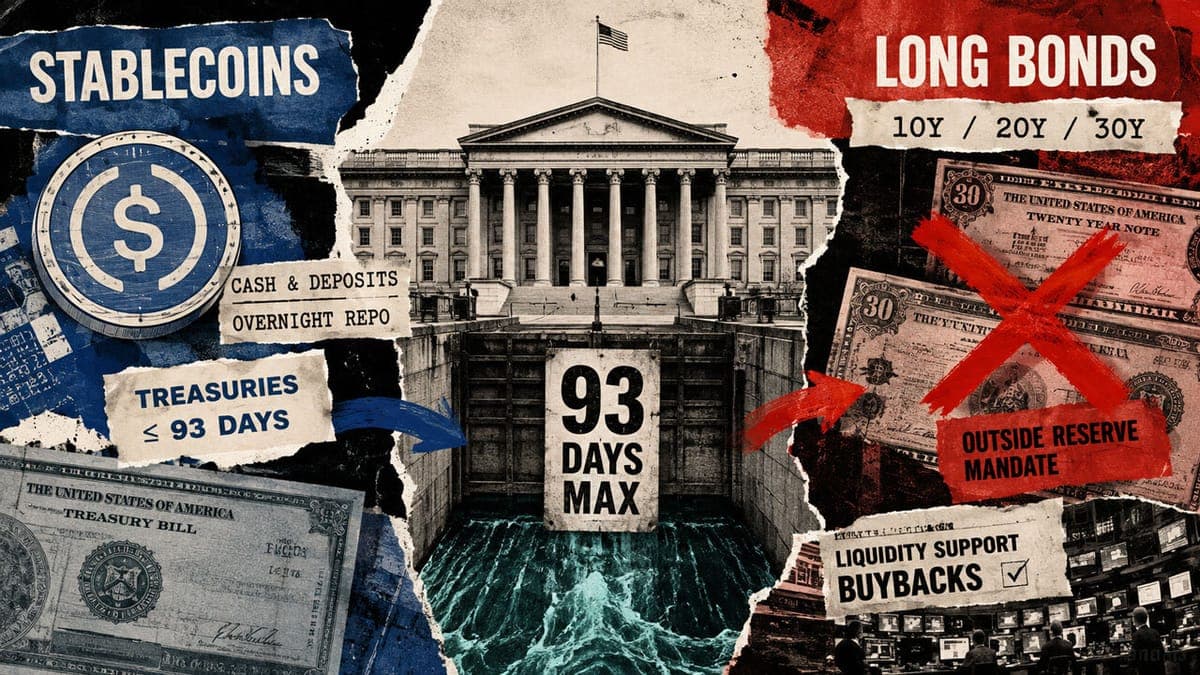
The federal framework for permitted payment stablecoins channels reserves into cash-like instruments and Treasuries with no more than 93 days remaining. Farther out on the curve, the Treasury Department said on Aug. 19 that it would at least double the maximum size of liquidity-support buybacks in the 10- to 20-year and 20- to 30-year nominal sectors beginning Sept.
Market Dynamics
Together, those developments test a broad claim about digital dollars funding the United States. Stablecoin growth can reinforce demand for bills and overnight Treasury financing. Direct support for long-duration bonds remains outside the reserve mandate, while any connection to Bitcoin runs through wider financial conditions rather than a reserve trade.
The 93-day wall defines the stablecoin bid The GENIUS Act requires permitted issuers to maintain identifiable reserves of at least one dollar for every payment stablecoin outstanding. Eligible assets include U. currency and Federal Reserve balances, withdrawable bank deposits, Treasuries with an original or remaining maturity of 93 days or less, qualifying overnight repo and reverse repo, government money-market funds invested in those instruments, regulator-approved similarly liquid federal assets, and qualifying tokenized versions.
The menu extends beyond Treasury bills, yet it remains built around liquidity and short duration. A newly issued 10-year note or 30-year bond falls outside the direct Treasury reserve category. Implementation is still in progress.
Market Impact
The law was enacted in July 2025, but its general effective date is the earlier of Jan. 18, 2027, or 120 days after final implementing rules. The Office of the Comptroller of the Currency issued its framework as a proposal in February.
19, the Comptroller said the final OCC rule was expected by November. Current issuer portfolios show how short-duration reserves work in practice; they do not establish that every issuer already operates under a completed federal regime. Related Reading Treasury just put a deadline on offshore stablecoins’ access to US customers GENIUS reserves favor cash-like assets Cash, deposits, overnight repo and Treasuries at or below 93 days Official statute A direct front-end demand channel Demand for 10- to 30-year bonds Circle's reserves are short duration Overnight Treasury repo, short Treasuries and bank cash July USDC reserve report) A large issuer already uses a cash-like mix How much reserve growth is new Treasury demand Treasury is expanding long-end buybacks Off-the-run 10- to 30-year nominal coupons Treasury announcement More potential liquidity support for long bonds A guaranteed purchase total or central-bank easing Stablecoin flows move bill yields Three-month Treasury bills BIS working paper A measurable front-end price effect Reliable transmission to longer maturities or Bitcoin Circle provides a live example of short-duration reserve behavior rather than proof of systemwide demand.
Its second-quarter filing put USDC circulation at $73. 269 billion on June 30. A more detailed July assurance report) showed $71.
Crypto markets are watching this development closely as investors weigh its potential impact on prices.