Bitcoin miner AI pivot hits roadblock with New York 50 MW permit freeze
New York has become the first US state to impose a statewide moratorium on large new data centers, creating an early regulatory test for Bitcoin miners that are rebuilding their businesses around artificial...
Bitcoin 1 Minute
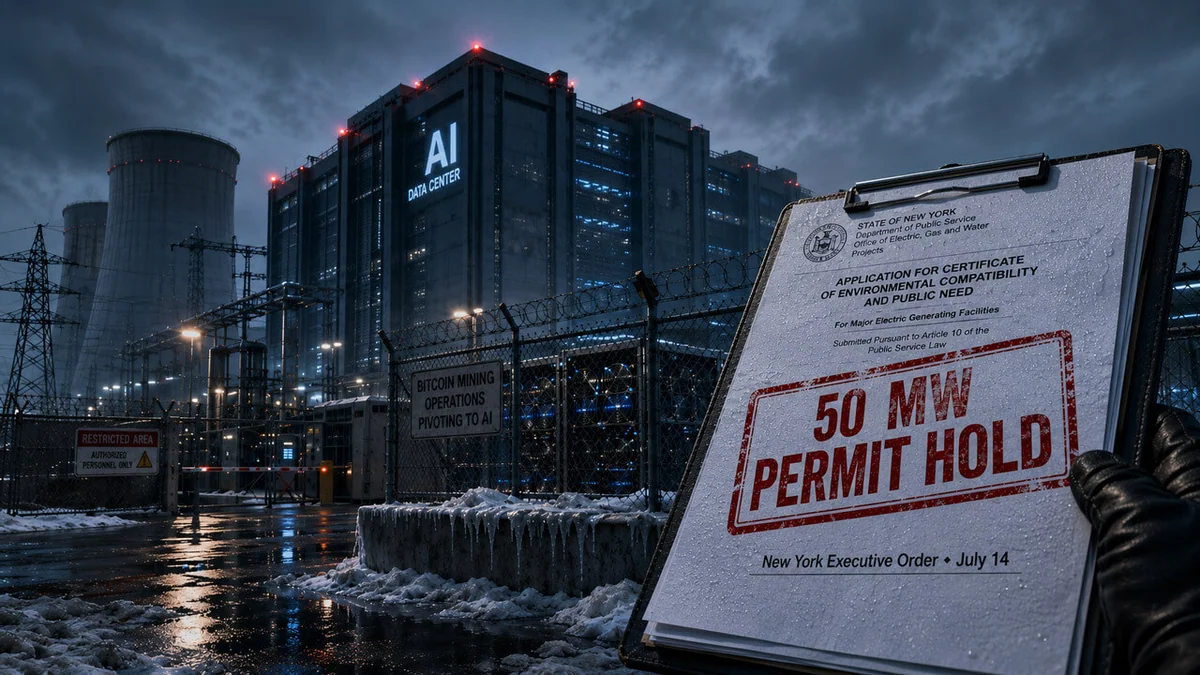
An important story is making waves across the blockchain ecosystem. New York has become the first US state to impose a statewide moratorium on large new data centers, creating an early regulatory test for Bitcoin miners that are rebuilding their businesses around artificial intelligence. Kathy Hochul signed an executive order directing state regulators to pause incomplete permit applications for new or expanding data centers capable of consuming at least 50 megawatts of power. The temporary halt will remain in effect while officials study the projects’ effects on electricity demand, water supplies, air quality, noise, and surrounding communities.
Applications declared complete before the order can continue, while local permits remain outside its scope. The measure therefore stops a portion of the development pipeline rather than every data-center project planned or under construction in New York. New York’s new action follows a regulatory model the state previously applied to Bitcoin mining.
Market Dynamics
In 2022, the state imposed a two-year moratorium on certain air permits for fossil-fuel power plants supplying electricity directly to proof-of-work mining operations while officials conducted an environmental review. The latest order expands the state’s scrutiny from a narrow group of crypto facilities to large computing projects that serve AI, cloud services, and other digital businesses. While Bitcoin mining is absent from the current order, the facilities it covers closely resemble the infrastructure that an increasing number of miners hope to operate.
Over the past year, public BTC mining companies have been converting sites built around large power connections, substations, and industrial land into campuses capable of hosting the graphics processors used for AI. New York’s action therefore introduces a potential obstacle for an industry seeking to reduce its exposure to Bitcoin prices and the worsening economics of producing the cryptocurrency. BTC miners have tied their next growth cycle to AI Bitcoin miners have committed billions of dollars to AI infrastructure, seeking more predictable revenue from the power-rich sites originally built to produce the top crypto.
Publicly traded miners have announced more than $70 billion in contracts to host AI and high-performance computing workloads. Matthew Kimmell, an investment strategist at CoinShares Valkyrie, estimated that AI could generate roughly 80% of public miners’ revenue by the end of 2026. The opportunity is being driven by an unprecedented expansion in technology spending.
Market Impact
Goldman Sachs estimates that annual AI capital expenditure could reach $765 billion in 2026 and rise to $1. 6 trillion by 2031 as companies invest in data centers, chips, power generation, transmission infrastructure and cooling systems. Projected Spendings on AI Infrastructure Over The Next 5 Years (Source: Goldman Sachs) Bitcoin miners are positioned to supply some of the most constrained parts of that buildout.
Many of these firms already control industrial land, large electricity allocations, energized substations and grid connections that can take years for new developers to secure. They also have experience operating power-intensive computing facilities around the clock. Keel Infrastructure, formerly known as Bitfarms, illustrated the scale of the transition this week after officials in Sherbrooke, Quebec, conditionally approved a land sale tied to its proposed C$1.
8 billion high-performance computing campus. Keel plans to consolidate 96 megawatts of electricity currently distributed across three Bitcoin-mining facilities into a single AI data-center site. The company has made high-performance computing its primary growth business and plans to continue operating its remaining Bitcoin mines as long as they remain profitable or until the sites are needed for redevelopment.
Crypto markets are watching this development closely as investors weigh its potential impact on prices.