Bitcoin’s first institutional bear market is starting to take shape and draining liquidity
In an institutional bear market, a Bitcoin ETF redemption is almost aggressively boring. An investor sells shares, an authorized participant returns a large block to the trust, and the fund either pays cash or transfers...
Bitcoin 1 Minute
A notable development has hit the crypto markets. In an institutional bear market, a Bitcoin ETF redemption is almost aggressively boring. An investor sells shares, an authorized participant returns a large block to the trust, and the fund either pays cash or transfers BTC. Its assets shrink while the shares keep trading near net asset value and the custodian carries on.
Since the SEC approved in-kind redemptions in July 2025, the coins themselves can leave through this process without forcing the trust to sell them on the market. In 2022, the exit often began with a disabled withdrawal page and ended in bankruptcy court. But now, in 2026, it can begin with a portfolio rebalance and end on an account statement.
Market Dynamics
The fund gets smaller, a source of demand fades, and, depending on how the redemption is handled and hedged, selling can appear elsewhere in the market. The machine keeps working while the investor takes the loss. That difference is getting harder to dismiss.
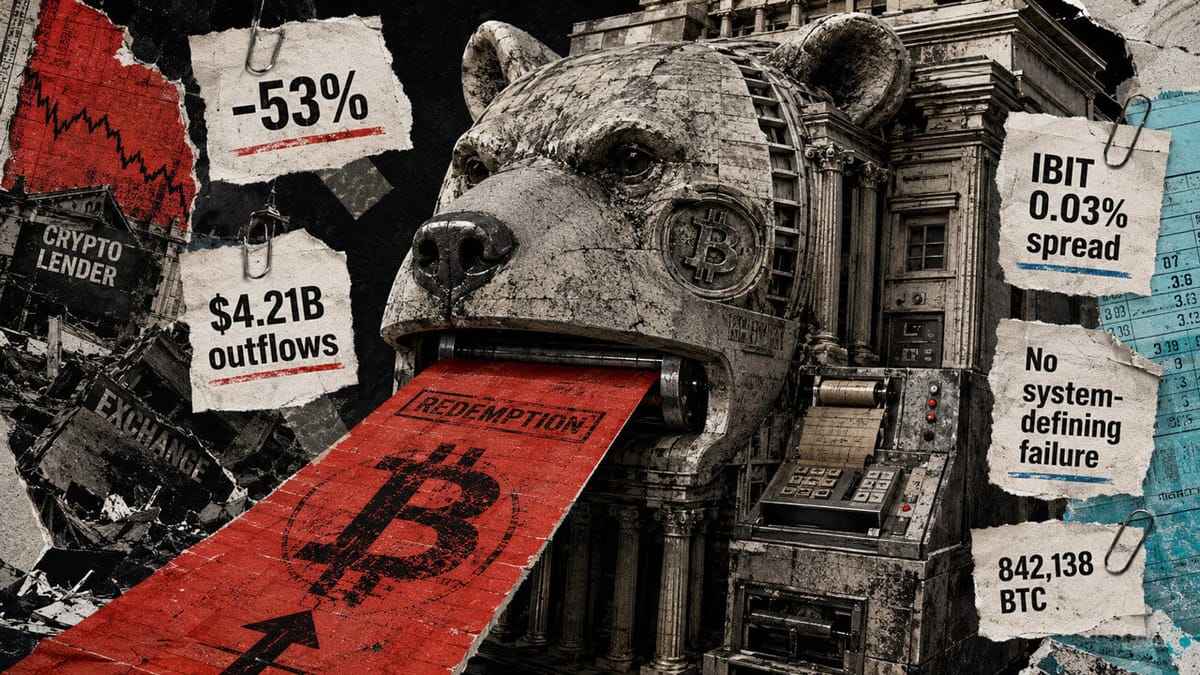
Bitcoin reached $126,223 in October 2025, traded below $59,000 on July 1 and recovered to roughly $64,000 in early August. The deepest leg erased about 53%, and the price was still down almost half from its peak at the start of this week. calculated a 33% loss for 2026 by early June, Bitcoin's worst start to a year in more than a decade.
A drop that large qualifies as a bear market under any useful definition. It has also left the biggest investment products, custodians and market makers functioning normally. Bitcoin may be going through its first institutional bear market, one in which Wall Street distributes losses efficiently enough to keep any single failure from defining the entire decline.
Market Impact
The crash moved to the redemption desk Most of the previous Bitcoin bear markets came with easy villains. The 2018 one followed the initial coin offering boom and erased about 84% from the price in a market still dominated by retail buyers. The 2021–2022 one cut Bitcoin by roughly 77%, then moved through the balance sheets of Terra, Three Arrows Capital, Celsius, Voyager, BlockFi and FTX.
A Federal Reserve review of the 2022 collapse traced how Terra's failure damaged Three Arrows, whose defaults then struck the lenders that had financed it. Falling collateral triggered margin demands and forced sales. Withdrawal freezes sent customers running for whatever cash they could recover, pushing more firms toward court.
Every broken institution made the remaining ones look weaker. The current cycle has delivered a different mix of causes and conditions. Galaxy Research measured the drawdown at 51% by June 9, eight months from the peak, while each of the previous two cycles took roughly 12 months to travel from the top to the bottom.
Crypto markets are watching this development closely as investors weigh its potential impact on prices.