Chainlink’s latest stablecoin push targets the capital stuck in bank FX settlement
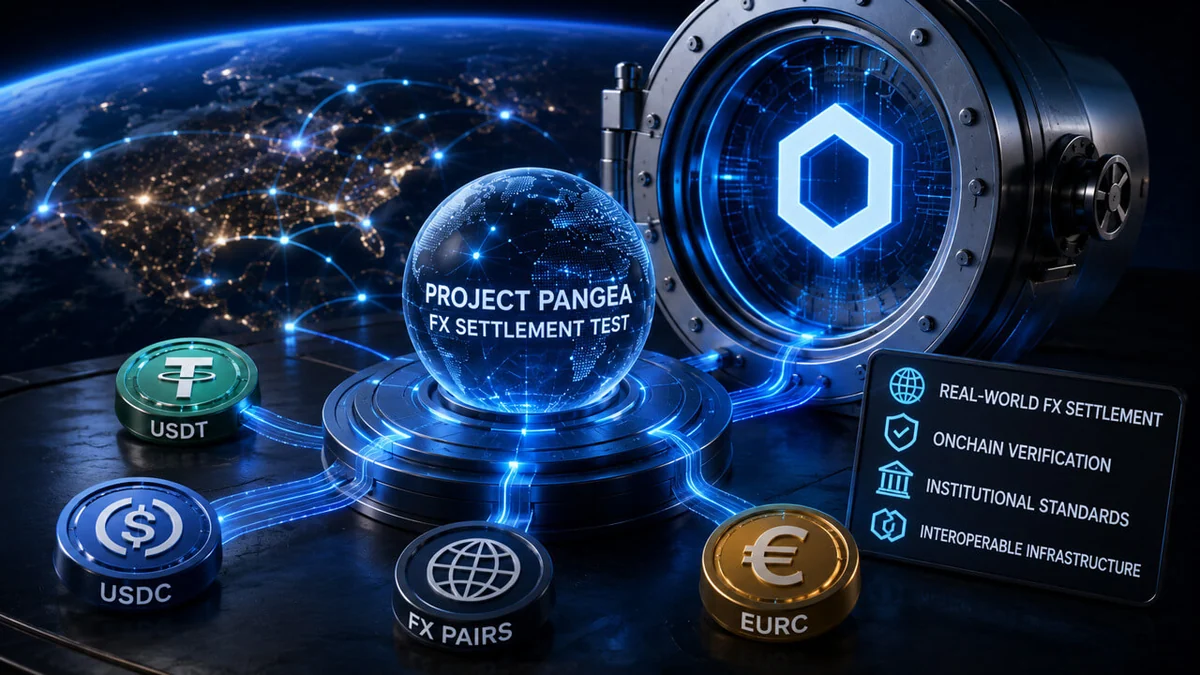
Chainlink's Project Pangea turns stablecoins toward a quieter but consequential job: helping banks settle foreign-exchange trades with less time between trade execution and final exchange of funds. The June 23...
Bitcoin 1 Minute
An important story is making waves across the blockchain ecosystem. Chainlink's Project Pangea turns stablecoins toward a quieter but consequential job: helping banks settle foreign-exchange trades with less time between trade execution and final exchange of funds. The June 23 announcement from Chainlink describes a framework for T+0 international FX settlement designed around compliant fiat-referenced digital assets, including EUR and KRW stablecoins. T+0, or same-day settlement, means a transaction is completed, and ownership and payment are exchanged on the same day the trade is executed, rather than waiting one or more business days for final settlement.
That makes the project a test of settlement risk. If a euro stablecoin and a Korean won stablecoin can move against each other in direct payment-versus-payment settlement, the useful outcome is a shorter window in which one party has paid while the other side is still waiting. The potential reward is freed-up capital and lower counterparty exposure if controlled bank trials show the model can work beyond an announcement.
Market Dynamics
A bank workflow test for FX desks Project Pangea centers on a specific institutional problem: FX markets are constantly moving, but settlement often depends on processes that separate trade execution from the final exchange of funds. The announcement frames the target as a shift from slower settlement cycles to T+0 atomic settlement, in which both currency legs are exchanged simultaneously. In plain English, the test asks whether compliant stablecoins can become settlement instruments for banks while those banks keep the messaging rails they already know.
Chainlink's capital markets materials describe the project as connecting bank instructions through existing SWIFT infrastructure and ISO 20022 messaging, with Chainlink infrastructure translating those instructions into on-chain settlement activity. Swift's own ISO 20022 guidance shows why that workflow compatibility is important. ISO 20022 is the structured messaging standard through which banks increasingly coordinate cross-border payment instructions.
The EUR/KRW pairing is also important. The framework points to compliant regional currencies, with Qivalis representing the euro side and FairSquareLab and UniKA tied to the Korean market. That keeps the experiment focused on whether stablecoins can support bank FX settlement between jurisdictions that already have their own regulatory and banking systems.
Market Impact
A compact way to read the announcement is to separate what the project is testing from what banks still need to see. A framework for T+0 FX settlement using compliant EUR and KRW stablecoins Scaled bank use for live FX settlement A payment-versus-payment design for both sides of a currency trade Bank-grade liquidity, redemption, and dispute handling A way to preserve Swift and ISO 20022-style bank workflows while changing settlement mechanics Operational approvals inside treasury, legal, risk, and compliance teams An institutional settlement and capital-efficiency experiment Clear rules for the exact stablecoins used in real transactions The institutional value sits beyond raw transfer speed. Pangea aims at the harder operating question of whether regulated stablecoins can reduce the operational and counterparty risk embedded in institutional FX settlement.
Payment-versus-payment links the delivery of one currency to the delivery of the other. In traditional FX operations, settlement delays can leave firms exposed if one leg completes before the other. Pangea's atomic-settlement framing says the euro and won legs should move together, which would reduce that mismatch if the framework works in controlled bank trials.
That is where stablecoins become bank infrastructure rather than consumer tokens. A compliant EUR stablecoin and a compliant KRW stablecoin would need reliable issuance, redemption, liquidity, controls, and legal treatment before banks could rely on them for production settlement. The announcement describes a framework and development path ahead of any completed market utility.
This shift continues to shape the digital-asset landscape, with analysts examining its near-term effects.