
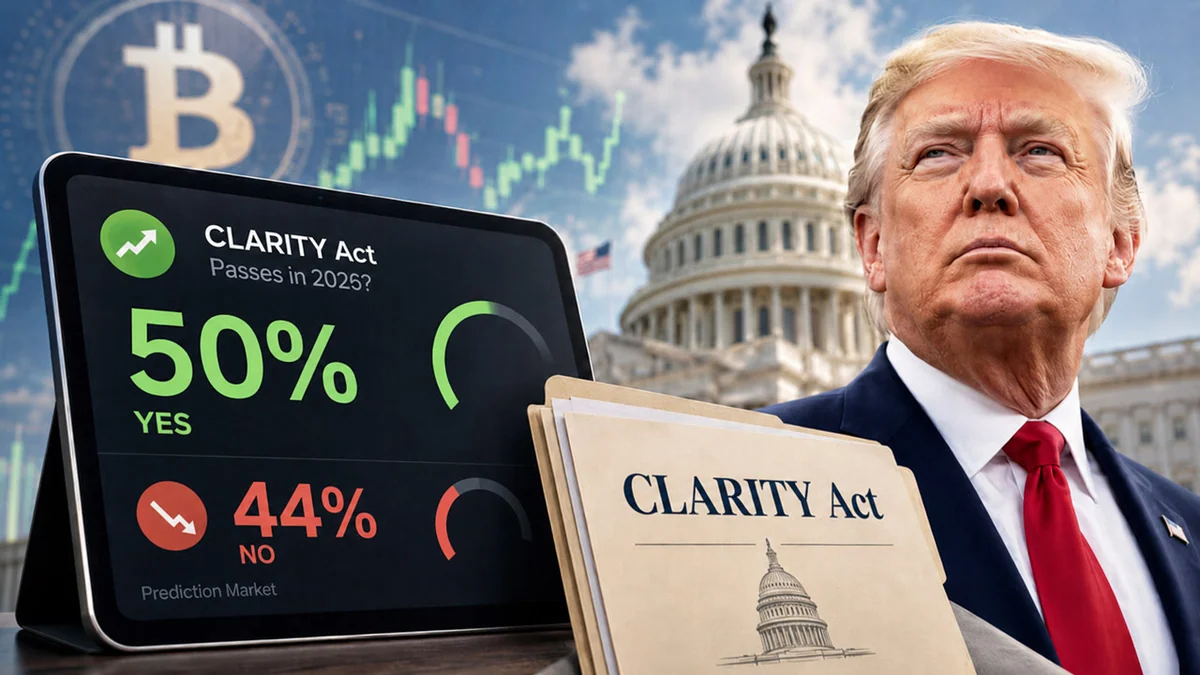
CLARITY Act chances of passage this year falls to 50% after Trump’s new demands
The CLARITY Act, the crypto industry’s most important bill in Congress, is running out of time. The bill, which would establish federal rules for the crypto industry, is increasingly at risk of slipping deeper into the...
Bitcoin 1 Minute
A notable development has hit the crypto markets. The CLARITY Act, the crypto industry’s most important bill in Congress, is running out of time. The bill, which would establish federal rules for the crypto industry, is increasingly at risk of slipping deeper into the 2026 election year amid renewed partisan fights and a new demand from President Donald Trump that has made an already difficult path more uncertain. As a result, crypto firm Galaxy Digital has cut its estimate of the bill becoming law this year to 50%, down from 60% earlier in June.
The firm said the downgrade was tied mainly to the Senate calendar, not to a collapse in negotiations over the legislation's substance. Meanwhile, participants on the decentralized prediction platform Polymarket have adopted an even more skeptical outlook, currently pricing the probability that the legislation will become law this year at just 44%. CLARITY Act Chances of Passage in 2026 (Source: Polymarket) Senate calendar tightens The primary obstacle facing the digital asset framework is time.
Market Dynamics
Lawmakers are confronting a severely truncated schedule before departing Washington for the traditional late-summer recess. In a recent note to clients, Galaxy Digital researchers emphasized that the downgrade in their forecast stems strictly from scheduling realities. For the legislation to clear the upper chamber, it requires a unified text bridging the Senate Banking and Agriculture committees, followed by a formal floor debate and a potentially lengthy amendment process.
Any final Senate product would then need subsequent approval in the House of Representatives. However, the timeline for these maneuvers is rapidly evaporating. Analysts note that Senate Majority Leader John Thune would likely need to formally schedule debate time by the first week of July to ensure a final vote before the August break.
Failing to secure a firm commitment for July floor time would likely push consideration into September. Historically, advancing complex or contentious financial regulations becomes exceedingly difficult in the immediate run-up to a national election. Currently, the legislation remains stalled on the Senate calendar, where it was placed after advancing out of the Banking Committee in mid-May.
Market Impact
No procedural motions to initiate debate have been filed. Trump's demand adds pressure CLARITY Act's delay is also exacerbated by fierce competition for the Senate’s most valuable commodity: floor time. Galaxy Digital noted that the digital asset bill is currently vying for attention against several urgent national security and domestic policy priorities, including the annual defense authorization act and the reauthorization of key surveillance programs under the Foreign Intelligence Surveillance Act (FISA).
Complicating matters further is an unexpected political standoff involving President Donald Trump, which threatens to derail the legislative queue. Trump recently declared his opposition to a bipartisan housing bill unless lawmakers concurrently pass the SAVE Act. The housing bill had sailed through both chambers with overwhelming support, but its signing was abruptly canceled by the US president.
The SAVE Act is a deeply contentious elections bill that would mandate strict documentary proof of US citizenship for voter registration, as well as new photo identification requirements for federal ballots. While the measure narrowly passed the Republican-controlled House earlier this year, it faces steep opposition in the Senate, where it lacks the 60 votes necessary to bypass a filibuster. By tying the broadly supported housing legislation to the polarizing voting measure, the president has injected a volatile fight into the pre-recess schedule.
Crypto markets are watching this development closely as investors weigh its potential impact on prices.