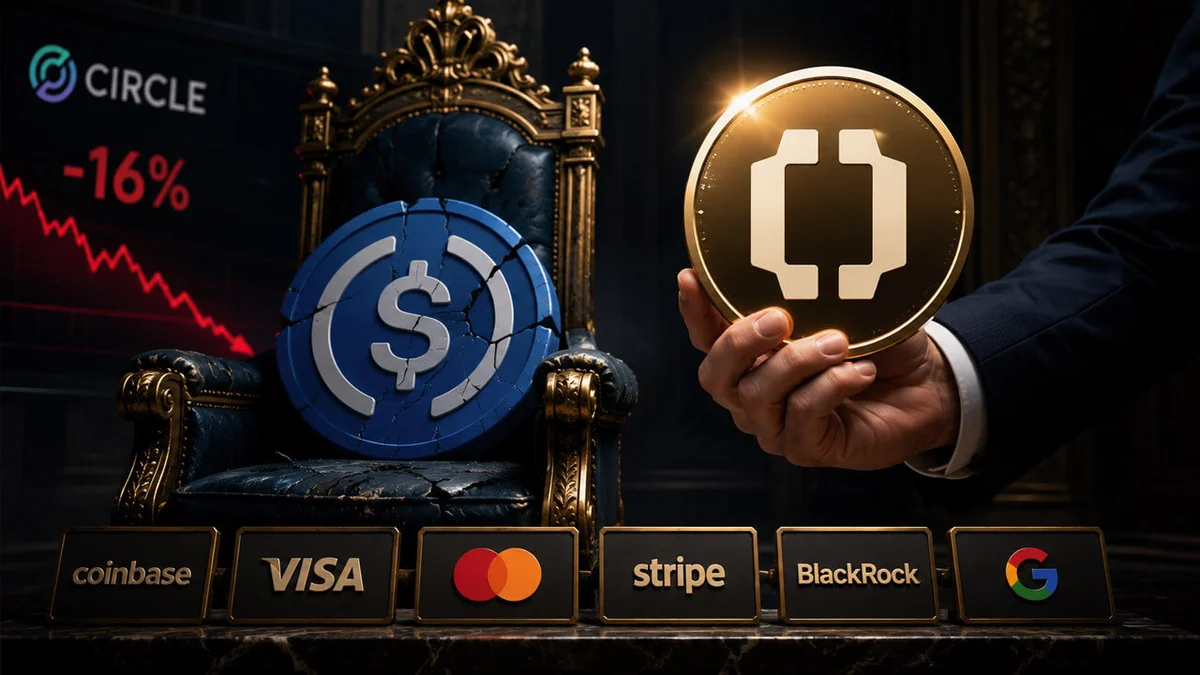
Coinbase helped build USDC – Why is it now backing the stablecoin trying to replace it, Open USD?
The stablecoin market has long rewarded the companies that issue digital dollars. They take in customer cash, hold reserves in short-term government securities, and earn the yield. Now, the companies that distribute...
Bitcoin 1 Minute
A notable development has hit the crypto markets. The stablecoin market has long rewarded the companies that issue digital dollars. They take in customer cash, hold reserves in short-term government securities, and earn the yield. Now, the companies that distribute those tokens want more of the economics.
That tension is at the center of Open USD (OUSD), a planned stablecoin backed by more than 140 financial, technology, and crypto firms, including Coinbase, Visa, Mastercard, Stripe, BlackRock, and Google. The project promises free minting and redemption for businesses, as well as a reserve-income model that sends more value to the platforms driving adoption. For Circle, the USD Coin (USDC) stablecoin issuer, the most important name on that list is Coinbase.
Market Dynamics
The exchange helped turn USDC into one of crypto’s most widely used dollar tokens. Coinbase said in its first-quarter report that more than 25% of USDC in circulation, or about $19 billion on average, was held across its products. It also said Base, its layer-2 network, processed 62% of global on-chain stablecoin transaction volume during the quarter.
That makes Coinbase’s support for OUSD more than a symbolic endorsement. It gives Circle’s most important distribution partner a stake in a rival model just as the economics of stablecoin issuance are becoming more contested. The cost of distribution OUSD's consortium launch represents a direct challenge to the incumbent stablecoin sector, which currently commands a market capitalization exceeding $320 billion.
For years, pure-play issuers like Circle and Tether have operated high-margin models by retaining the interest income generated from the billions of dollars backing their tokens. However, as stablecoins migrate from speculative trading assets to foundational rails for global settlement and payments, the companies providing the actual customer pipelines are demanding a fundamental realignment of the revenue-sharing architecture. OUSD addresses this by aiming to eliminate standard minting or redemption fees and to structurally return most of the reserve yield directly to its distribution partners.
Market Impact
The immediate market impact was palpable, with Circle’s shares falling 16% on the day the consortium was announced. The drop underscores investor anxiety regarding the durability of Circle's core commercial relationship with Coinbase. That relationship has historically been highly lucrative but increasingly complex.
In 2024, Circle paid Coinbase $908 million under their revenue-sharing agreement, reflecting the exchange’s role as one of USDC’s most important distribution and liquidity channels. Public financial disclosures show that Coinbase captured a larger share of the USDC revenue pool than many investors expected, highlighting the premium placed on distribution over raw issuance. For the full year 2025, Coinbase's stablecoin-tied revenue totaled approximately $1.
35 billion, accounting for roughly 19% of its total annual revenue. So, Coinbase's pivot toward a founding role in OUSD gives it a powerful alternative asset exactly when its current contract with Circle approaches a critical milestone. The distribution agreement between the two firms operates on a three-year cycle, with the next expiration date set for August 2026.
Crypto markets are watching this development closely as investors weigh its potential impact on prices.