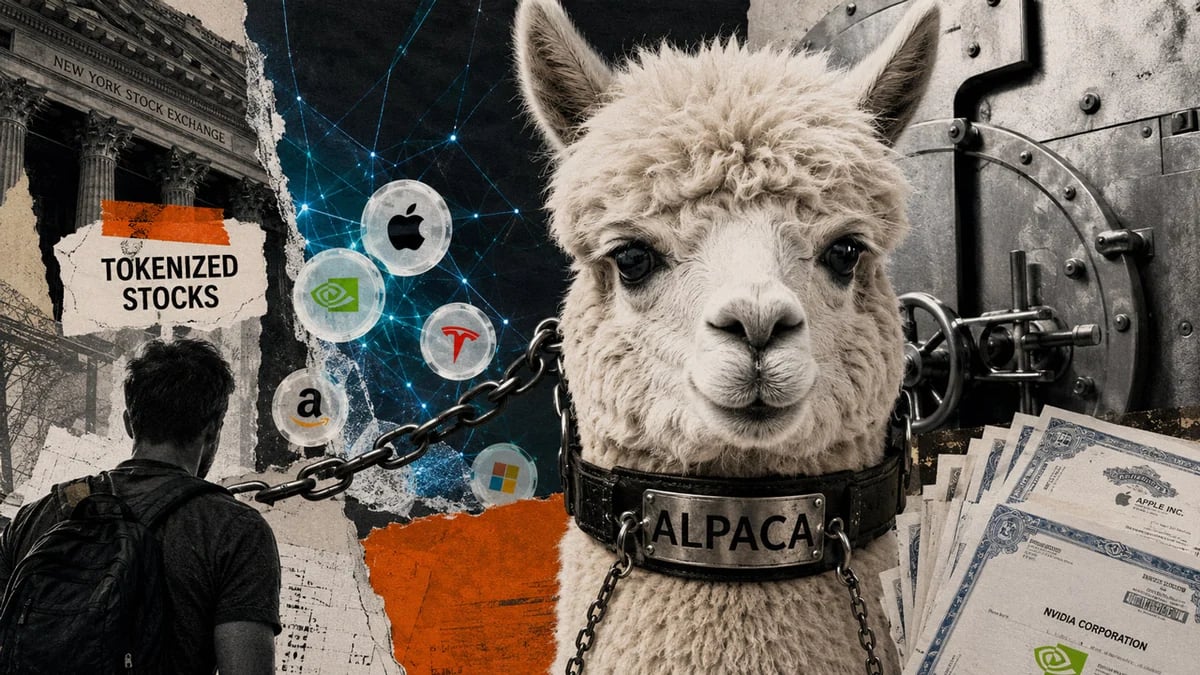
Crypto promised to eliminate stockbrokers, but 94% of its tokenized market now relies on an Alpaca
Alpaca says it custodies more than $1.5 billion of shares backing tokenized equities, which, by public tracker measurements, would represent most of the market. With DTCC preparing to launch its own tokenization service...
Bitcoin 1 Minute
Here is the latest from the digital-asset markets: Alpaca says it custodies more than $1. 5 billion of shares backing tokenized equities, which, by public tracker measurements, would represent most of the market. With DTCC preparing to launch its own tokenization service in October and the SEC warning that third-party stock tokens can expose investors to additional ownership and intermediary risks, the numbers reveal a concentrated brokerage layer beneath a market promoted as decentralized.
Tokenization is the practice of representing a real-world asset as a digital token on a blockchain, so that owning the token stands in for owning, or at least tracking, the thing itself. Applied to equities, it means a version of Apple or Nvidia stock that exists in a crypto wallet, trades on crypto exchanges around the clock, and moves between buyers in minutes without touching a traditional brokerage account. A buyer from basically anywhere in the world can hold exposure to US companies through the same app they use for Bitcoin, at any hour, in fractional amounts, and the market has grown into hundreds of tokenized assets spread across Solana, Ethereum, and several other chains, issued by competing platforms and sold through exchanges that never close.
Market Dynamics
The sales pitch attached to all of this was disintermediation, the removal of all the intermediaries who stand between an investor and a share. Follow any of these tokens back toward the actual stock market, though, and the trail converges on a single California brokerage most people have never heard of. Alpaca, a self-clearing broker-dealer founded in 2015, says it clears or custodies roughly 94% of tokenized US stocks and ETFs and holds more than $1.
5 billion of the underlying shares behind them. On July 16, it raised $135 million led by Peak XV, with debt from Kraken's parent Payward and from BMO lifting the package to $435 million. A market designed to reduce intermediaries has produced a dominant new one.
The machine behind tokenized stocks A tokenized stock only works if someone with a brokerage license buys the real share, holds it under US custody rules, and keeps the token supply matched to the inventory. Very few established brokers wanted that business when crypto platforms came asking, so the issuers who built this market, including Kraken's xStocks, Dinari, and Ondo, routed through the broker willing to take them. Alpaca became the common counterparty by showing up, and its role has now grown far beyond just warehousing shares.
Market Impact
A company spokesperson told that Alpaca holds the underlying stocks one-to-one, executes and clears the trades, and runs real-time minting and redemption through its Instant Tokenization Network, the system that converts a brokerage position into an onchain token and back. It processes the corporate actions on those shares, meaning dividends, splits, and similar events, for every partner. It also supplies stock lending, short locates, and insured cash sweeps to the issuers and their market makers.
Market makers are the trading firms that keep token prices aligned with the real stock, and it has partnered with Broadridge to bring proxy voting and shareholder governance to tokenized equities. The client list the spokesperson cited includes Binance, Kraken, Ondo, and Dinari, which covers most of the product families a retail buyer will actually encounter. Alpaca's own clarification of the $1.
5 billion confirmed the number while also making it much more complicated. The spokesperson said the number, measured as of July 2026, counts only the stocks backing tokens live and in circulation, excluding the equities Alpaca custodies for ordinary brokerage clients. That definition invites a direct comparison with public data, and the comparison gets murky pretty fast.
This shift continues to shape the digital-asset landscape, with analysts examining its near-term effects.