Easy money on Polymarket and Kalshi is disappearing as prop firms deploy AI agents
On July 28 and 29, the Federal Reserve meets to set its next rate decision, and traders will try to price the outcome through bonds, currencies, crypto and contracts that settle directly on what the central bank...
Bitcoin 1 Minute
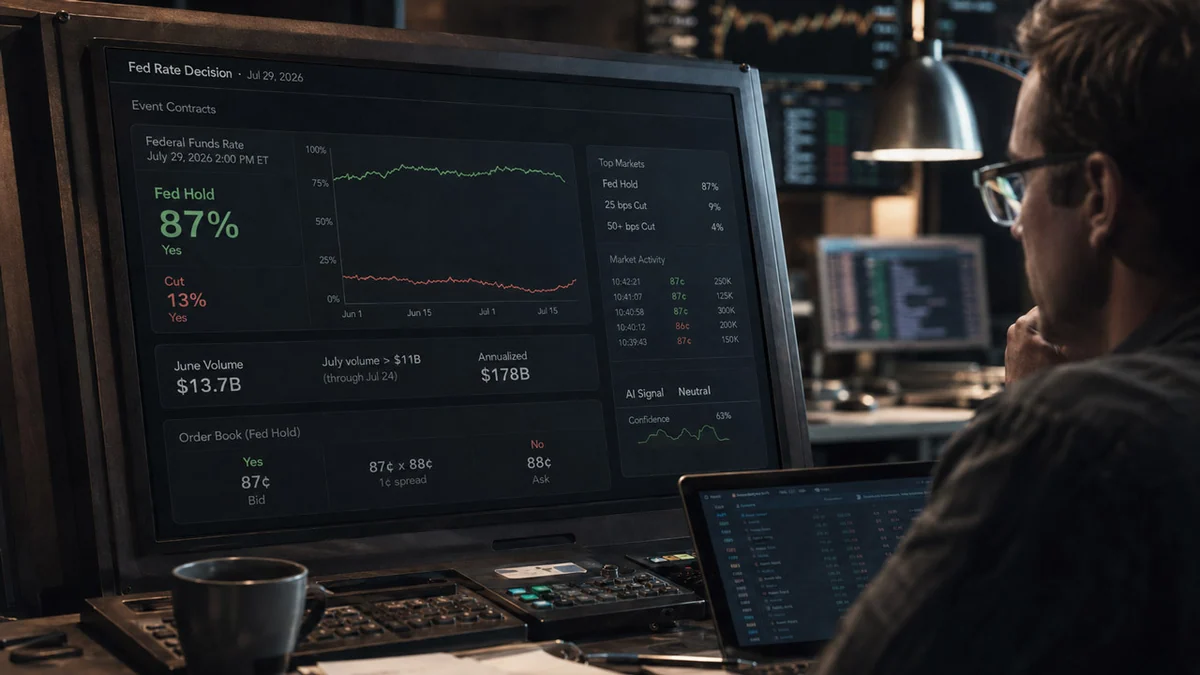
An important story is making waves across the blockchain ecosystem. On July 28 and 29, the Federal Reserve meets to set its next rate decision, and traders will try to price the outcome through bonds, currencies, crypto and contracts that settle directly on what the central bank announces. polled 104 economists on July 21 and found every one of them expected the Fed to hold at 3. Kalshi's July contract puts 87% on that outcome, with roughly $29.
7 million in volume on the page, and someone still has to put a price on the other 13%. That counterparty now includes market makers, quantitative firms, funded-trading shops and AI agents that watch prices, compare related contracts and update probabilities around the clock. Institutions are testing event contracts, and brokers are wiring in liquidity providers.
Market Dynamics
Funded-trading firms are starting to treat resolved contracts as a way to identify traders, human or algorithmic, who can price uncertainty better than the crowd. Together, these forces could deepen order books, speed up price discovery, and concentrate the edge among firms with the fastest infrastructure. Combined monthly volume across Kalshi and Polymarket reached its peak at $13.
7 billion in June, with July already registering over $11 billion. These numbers show prediction markets already trading at professional scale. Chart shows Kalshi and Polymarket monthly volume peaking at $13.
7 billion in June, with Kalshi's annualized volume reaching $178 billion. Kalshi said its annualized volume more than tripled over six months to $178 billion, that institutional volume climbed 800%, and that it completed its first customized block trade. Clear Street, Marex and Jump Trading have each built a piece of the access layer around that growth: Clear Street connects institutional clients to Kalshi, Marex works across both Kalshi and Polymarket infrastructure, and Jump helps institutions reach event markets directly.
Market Impact
AQR, Susquehanna, and OKX have advertised specialist prediction-market roles on top of that build-out. Corporate treasuries are testing these same contracts to hedge tariff and regulatory exposure, a demand that only works if someone else commits to pricing the other side of the trade, continuously and at size. Building a functioning market requires a supply side willing to quote both directions, compare related contracts across venues and correct a price the moment it looks wrong.
Measuring the edge Louis Régis, founder of the on-chain prop firm Propr and a former quantitative trader at Credit Suisse, argued that event contracts make trader selection more rigorous than conventional markets do, as the skill they reward is legible and the risk is bounded. A contract resolves against a defined outcome, so an allocator can examine whether a trader consistently priced probability better than the market. That test isolates skill more cleanly than a directional profit-and-loss record, where market direction and margin blend into the number.
The Foresight Arena benchmark estimates that detecting a real edge of two percentage points with reasonable statistical confidence takes about 350 resolved binary predictions, and confirming a one-point edge takes roughly four times as many. A short winning streak on a handful of Fed or election contracts can still come from a favorable market pick, a correlated position, or a rare outcome that happened to land right. Probability calibration Did the trader repeatedly buy probabilities that resolved too low or sell probabilities that resolved too high?
This shift continues to shape the digital-asset landscape, with analysts examining its near-term effects.