
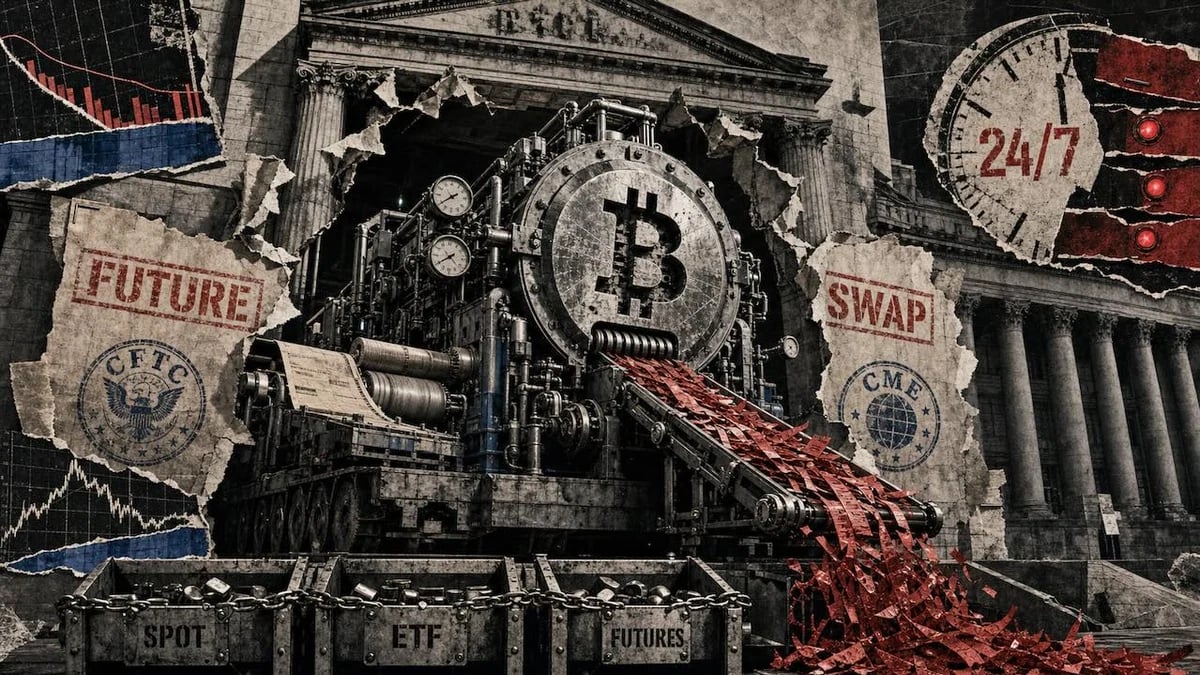
Multi-trillion-dollar offshore engine driving 90% of crypto trading arrives in America – and CME is suing to crush it
Coinbase began offering US perpetual-style futures on its CFTC-regulated derivatives exchange, starting with nano Bitcoin and Ethereum contracts that track spot prices, carry embedded leverage, and trade around the...
Bitcoin 1 Minute
An important story is making waves across the blockchain ecosystem. Coinbase began offering US perpetual-style futures on its CFTC-regulated derivatives exchange, starting with nano Bitcoin and Ethereum contracts that track spot prices, carry embedded leverage, and trade around the clock. This is a financial product that's responsible for most of the crypto leverage in the world, and it's now crossed into the US market. Aside from bringing another way to bet on Bitcoin, it's also bringing the entire machinery that essentially set offshore price discovery for years.
The US market is now importing funding payments, continuous leverage, and automatic liquidations across several exchanges, each one built to different specifications. Perpetual futures make up the large majority of crypto derivatives activity. Coinbase puts the figure at upwards of 90% of derivatives volume in some measures, with derivatives themselves accounting for roughly 80% of all crypto trading.
Market Dynamics
For years, all of that activity happened almost entirely on exchanges outside American oversight, and US traders who wanted in logged into offshore platforms through a VPN. The barrier broke on May 29, when the CFTC approved KalshiEX's BTCPERP as a futures contract referencing Bitcoin's spot price, and issued a policy statement inviting other exchanges to bring similar contracts through the same door. On June 12, the CFTC handed designated contract markets a conditional route to strip expiration dates off existing perpetual-style crypto futures and convert them into genuine no-expiry contracts.
The framework that made all of that possible is now being fought over in federal court. The outcome of that legal fight will shape how far perpetual futures can actually spread in the US market. On June 18, CME sued the CFTC and Chairman Michael Selig in the District of Columbia, asking a judge to vacate the Kalshi order and the policy statement that came with it.
With one stroke of his pen, the complaint argues, the chairman overrode Congress's definition of a swap and sidestepped the regulatory framework Congress built for that kind of derivative. CME's position is that perpetuals meet the statutory definition of swaps under the Commodity Exchange Act, which would pull them into a far heavier regime of dealer registration, capital rules and reporting, and would route the benchmark licensing back toward incumbents, like CME. Selig, the agency's sole confirmed commissioner, had approved Kalshi's application in a single day.
Market Impact
The CFTC isn't taking the challenge lightly. A spokesperson said CME had chosen to undertake lawfare against the agency and the administration's pro-innovation agenda, accused incumbents of fearing competition on a level playing field, and promised to have the suit, which it called frivolous, dismissed. The commercial stakes of this legal battle are already pretty high.
CME's complaint says Kalshi has self-certified more than a dozen additional crypto perpetuals under the order and that trading in them has already passed $1 billion. The agency has moved to defend its turf on other fronts too, suing Kentucky in late June over which authority governs contract markets. No ruling has come down, and the case is early, so every exchange now building a US perpetual product is doing it on a legal foundation a court could still rearrange.
What do perpetual futures now look like in the US? A conventional future expires on a set date, and a trader who wants to hold exposure past that date has to close the position or roll it into a later contract. A perpetual future is built to run indefinitely.
Crypto markets are watching this development closely as investors weigh its potential impact on prices.