How the “buy, borrow, die” tax trade is quietly loading DeFi pools with hidden credit risk
Imagine someone who bought ETH for $1,000, watched it climb to $4,000, and now wants to cash out $1,000. Selling one-quarter of the ETH would provide the cash, but it would also realize a $750 gain under US tax...
Bitcoin 1 Minute
A notable development has hit the crypto markets. Imagine someone who bought ETH for $1,000, watched it climb to $4,000, and now wants to cash out $1,000. Selling one-quarter of the ETH would provide the cash, but it would also realize a $750 gain under US tax treatment of digital assets held for investment. However, DeFi offers another way.
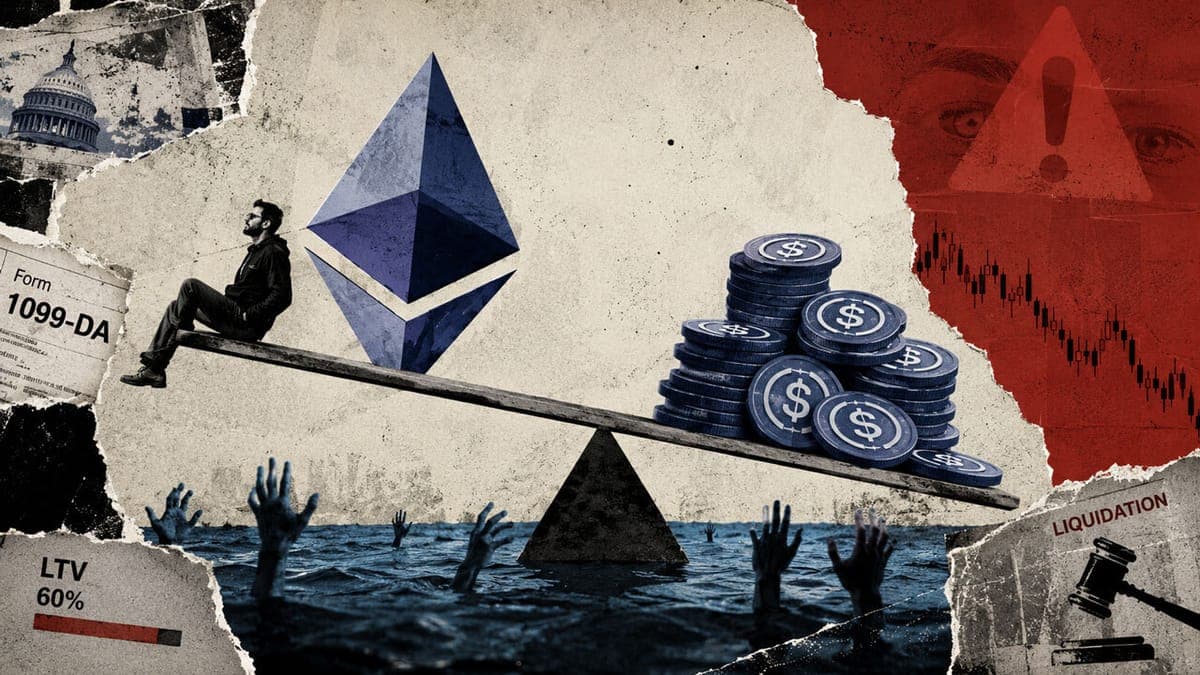
The owner can deposit the full ETH into a lending protocol, use it as collateral, and borrow $1,000 in a stablecoin designed to track the dollar. The loan doesn't count as taxable income, the ETH keeps its exposure to any future price increase, and the owner now has something they can spend or convert into dollars without selling the original asset. Sell 25% of ETH $1,000 $750 realized gain Reduced by 25% No liquidation risk Borrow stablecoin against ETH $1,000 No immediate taxable sale Full ETH exposure retained Debt, interest, liquidation risk While it saves the owner a lot of money in taxes, it also creates a fragile math problem.
Market Dynamics
The $1,000 debt begins at 25% of collateral worth $4,000, but a fall in ETH to $2,000 doubles that loan-to-value ratio to 50%, and interest accumulating on the debt pushes it higher. If the ratio crosses the protocol's limit, the code opens the collateral to liquidation, allowing an outside trader to repay part of the loan and claim some of the ETH at a discount. The borrower might have deferred a taxable sale, but the lending pool has taken on the risk created by the collateral price, the size of the debt, and the borrower's willingness to act before liquidation.
One person's tax decision essentially became part of a shared credit market funded by other users, most of whom know the wallet only as a string of letters and numbers. Lisa De Simone of the University of Texas at Austin, Peiyi Jin of the National University of Singapore, and Daniel Rabetti of NUS examined that connection in a working paper on tax planning and DeFi credit risk. They studied Venus, a DeFi lending protocol on BNB Smart Chain that allowed users to pledge crypto and borrow other tokens through rules enforced by smart contracts.
Their sample runs from Nov. 12, 2020, through July 31, 2022, and covers the 15 largest tokens on Venus. Roughly 13 million transactions became 1.
Market Impact
36 million daily borrower observations, which means the same wallet can appear once on every active day, and about 3% of traders experienced what the paper defines as a default. That definition needs some translation because a DeFi default looks different from a missed mortgage payment. The paper classified a borrower as defaulted when the loan remained above Venus's 60% loan-to-value limit for at least seven days without later borrowing or depositing, and its $133.
34 million total adds outstanding defaulted debt across each day it persisted. A single troubled loan can therefore contribute to several dates, making the total a measure of accumulated daily exposure rather than unique principal lost in one event. $4,000 $1,000 25% Comfortable cushion $3,000 $1,000 33% Risk rising $2,000 $1,000 50% Close to danger $1,667 $1,000 60% Liquidation threshold Below $1,667 $1,000+ interest Above 60% Liquidation risk active The billionaire trade gets a wallet The traditional version of this strategy is known as “buy, borrow, die.
” Investors buy an asset, let it appreciate, and borrow against it to live without realizing the gain through a sale. Continued borrowing can defer capital-gains tax for years, and US estate rules may reset the asset's tax basis when heirs inherit it, reducing the gain accumulated during the original owner's lifetime. This has usually been a rich person's trade because a private bank wants a client with valuable collateral and enough wealth to survive a downturn.
Crypto markets are watching this development closely as investors weigh its potential impact on prices.