Stopping a blockchain doesn’t always recover stolen funds – What actually happened when 3 networks pulled the plug
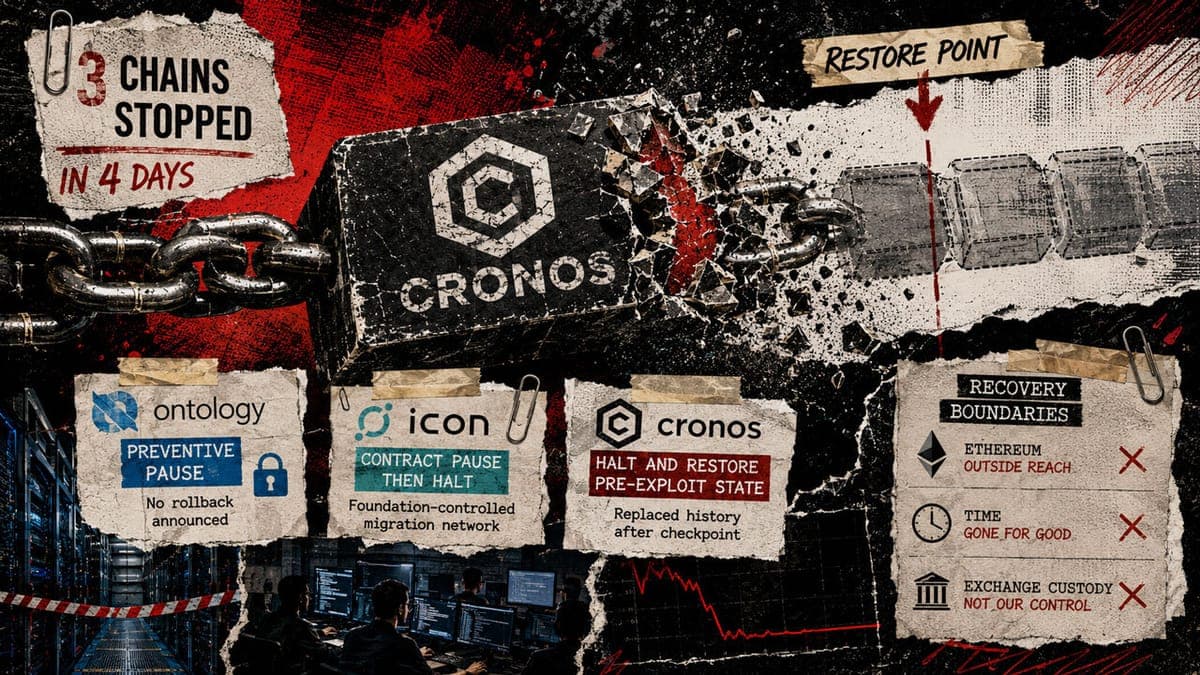
Three blockchain networks stopped producing blocks within four days. Each blockchain halt used different emergency powers, and Cronos alone also replaced part of its canonical history. Cronos said validators halted the...
Bitcoin 1 Minute
An important story is making waves across the blockchain ecosystem. Three blockchain networks stopped producing blocks within four days. Each blockchain halt used different emergency powers, and Cronos alone also replaced part of its canonical history. Cronos said validators halted the network by consensus after an exploit affected Tectonic, restored the chain to state from before the incident, and resumed production from block 90,896,189.
The action replaced state as well as stopping production. Transactions and state changes that existed only after the chosen restore point no longer belonged to the restarted canonical chain. Ontology and ICON used different emergency levers.
Market Dynamics
Ontology suspended block production before confirming malicious attack activity, and its Sept. 1 update said that activity did not compromise user assets. ICON first paused an affected contract, then halted a network that the ICON Foundation said it controlled during a migration period, after most of the affected ICX had already entered exchange custody.
A blockchain halt reveals only the first layer of control. The deeper questions are who can order the stop, whether they can replace accepted state, and which losses remain when funds cross into another chain or a centralized custodian. Cronos Tectonic exploit Halt and restore pre-exploit state Validator consensus; no tally or voting threshold in the restart notice Discarded post-checkpoint activity; funds on Ethereum outside Cronos's reach; final Tectonic accounting pending Ontology Potential concern found in a daily check; malicious activity later confirmed Preventive block-production pause; no rollback announced Core development team, technical team and validators; no emergency threshold disclosed Transactions unavailable during remediation and a network upgrade; no user-asset compromise identified ICON Replay exploit in migration contracts Contract pause, then network-wide halt Foundation-controlled migration network operating with a reduced core validator set Foundation-held loss; recovery of exchange-held ICX depends on custodians, legal process and law enforcement Cronos crossed the line from stopping to replacing state Cronos described the incident response as a “validator-consensus emergency action.
31 restart notice said block production resumed as of 23:49:01 UTC on Aug. 30 from block 90,896,189, using chain state restored to before the Tectonic exploit. Cronos's blockchain halt made the restore point an allocation decision.
Market Impact
Exploit-related state after the checkpoint disappeared from the canonical chain, along with any unrelated transactions that existed only in the discarded history. The restart notice gives no transaction inventory, validator tally, voting-power threshold or list of participants. Cronos's promised postmortem will need to explain both the procedure and the technical scope.
Related Reading Harmony weighs a full blockchain rollback after unauthorized minting floods exchanges with billions in ONE Even the amount protected by the intervention remains unsettled. TRM Labs estimated that roughly $75 million was borrowed after TONIC's price was manipulated, with about $6 million reaching Ethereum and around $68. 7 million reversed on Cronos.
Bitquery reported a larger gross outflow, about $8. 3 million on Ethereum and 10,961 discarded blocks. Those figures measure different scopes; Tectonic's final official loss remains pending.
This shift continues to shape the digital-asset landscape, with analysts examining its near-term effects.