
What the CLARITY Act Actually Does for Bitcoin
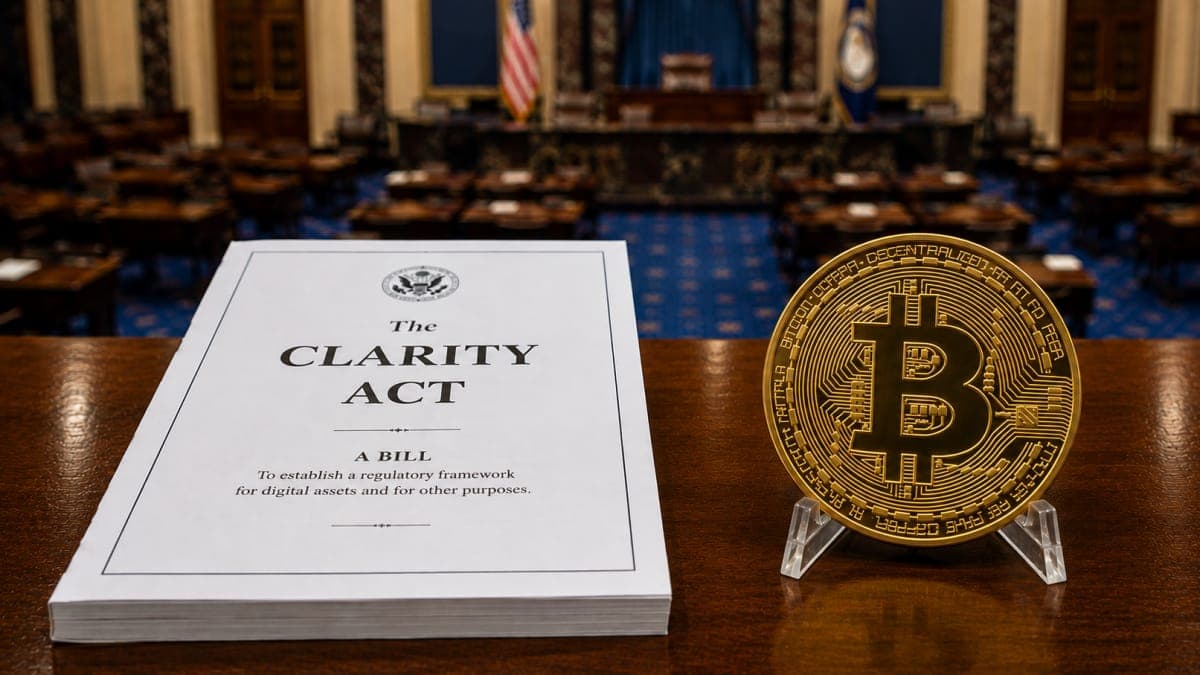
Bitcoin Magazine What the CLARITY Act Actually Does for Bitcoin In July 2025, House Republicans staged a coordinated three-bill blitz they called ‘Crypto Week;, advancing the GENIUS, CLARITY, and the Anti-CBDC...
Bitcoin 1 Minute
Here is the latest from the digital-asset markets: Bitcoin Magazine What the CLARITY Act Actually Does for Bitcoin In July 2025, House Republicans staged a coordinated three-bill blitz they called ‘Crypto Week;, advancing the GENIUS, CLARITY, and the Anti-CBDC Surveillance State Act in the same five day stretch. The GENIUS Act was signed into law within 24 hours, creating a regulatory framework for dollar-backed stablecoins. However, the other two bills weren’t so lucky.
The Anti-CBDC Surveillance State passed the House by an extremely narrow margin, and got stuck in Senate purgatory without a floor vote in place for over a year. Following the House’s bipartisan passage of the CLARITY Act, the bill landed in the Senate Banking Committee where it sat for nearly a year. When the bill finally emerged out of committee, its cover page included the phrase “Strike out all after the enacting clause and insert the part printed in italic.
Market Dynamics
”Translation: 100% of the bill had been rewritten. If you pull up the bill on Congress’ website today, you can see that the first 256 pages (the entire House-passed bill) are struck through, line by line, top to bottom. Then, starting on page 257, the Senate’s new version of the bill begins.
(This is still the official text on file; a further-updated draft has circulated since, but hasn’t been formally filed as an amendment. ) Given how much the bill has changed shape, it’s worth taking a step back and assessing how the CLARITY Act, in its post-June 1st form, actually affects Bitcoin, and if it can truly “act as the catalyst for the next bull run” as I see so often on X today. What the bill does do for Bitcoin Self-custody becomes a legally protected right Section 605, the ‘Keep Your Coins Act’, prohibits federal regulators from restricting or impairing a person’s ability to self-custody for any lawful purpose.
Self-custody currently has no statutory backing, and providing direct legislation creates a defense against future tyrannical powers requiring custodial intermediaries. While people often dismiss this threat as ‘fear mongering’ and ‘doomerism’, this type of overreach does have recent historical precedent. In 2020, Treasury Secretary Steven Mnuchin directed FinCEN to propose a rule targeting “unhosted wallets”.
Market Impact
It would have required exchanges to collect names and home addresses for anyone moving more than $3,000/day into their private wallet, and file reports to FinCEN for anything over $10,000/day. Although the rule ultimately lost momentum, it remained on the books and un-withdrawn for almost four years. During that period, any Treasury Secretary could have revived and finalized it without any new legislation.
This is the exact scenario Section 605 is written to prevent from happening again. Bitcoin developers, node operators, and non-custodial wallet makers get explicit immunity from money-transmitter liability Section 604, Blockchain Regulatory Certainty Act, says a “non-controlling” developer or provider can’t be classified as a money transmitting business for doing that. Prime examples are Samourai Wallet and Tornado Cash.
Both were open-source, non-custodial projects whose developers were criminally prosecuted under the theory that publishing the code made them unlicensed money transmitters. Samourai’s founders pleaded guilty in April 2026, and Tornado Cash’s Roman Storm was convicted on the same charge in August 2025. Section 604 does not undo either case, but it does draw a line so the next open-source developer doesn’t have to find out where it is in federal court.
Crypto markets are watching this development closely as investors weigh its potential impact on prices.