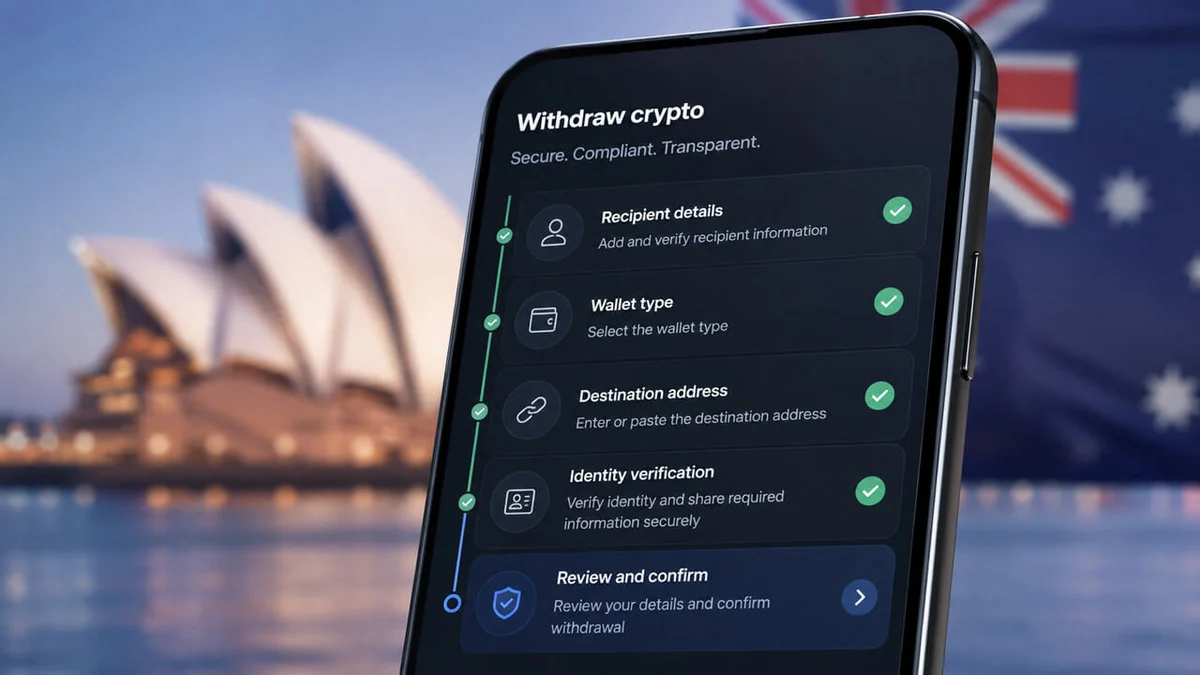
Australia’s new crypto transfer rules to make exchange withdrawals pass through identity checks
Australia’s July 1 AML/CTF deadline has turned regulated crypto transfers into a data workflow for exchanges and other virtual asset service providers. Users can still hold and move crypto in self-custody. The friction...
Bitcoin 1 Minute
An important story is making waves across the blockchain ecosystem. Australia’s July 1 AML/CTF deadline has turned regulated crypto transfers into a data workflow for exchanges and other virtual asset service providers. Users can still hold and move crypto in self-custody. The friction begins when funds pass through a reporting entity, where a transfer instruction can trigger identity, wallet, counterparty, secure-messaging, and record-keeping checks before assets move or become available.
AUSTRAC’s transitional rules deferred some AML/CTF obligations for new registrable virtual asset services until July 1, 2026, including the rules covering transfers of value involving virtual assets. The agency’s guidance says those deferred services were not required to comply with Travel Rule obligations for virtual asset transfers until that date. That runway has now closed.
Market Dynamics
For Australian exchanges and other virtual asset service providers, transfer instructions now carry more than an operational request. They may require identity collection and verification, wallet classification, counterparty checks, secure message handling, and records linking the payer, payee, wallet, and transfer path. How the transfer workflow changes The sharpest user-facing detail is the absence of a small-transfer carve-out.
AUSTRAC’s guidance on when the Travel Rule does not apply states that there is no minimum amount for a value transfer. The rule applies to international or domestic value transfers of any amount, unless a specific exception applies. That turns compliance friction into a question of both transfer type and transaction size.
Crypto users often associate additional checks with large withdrawals, suspicious flows, or bank-style thresholds. Australia’s framework points to a different operating rule. The key question is whether a reporting entity is providing a covered value-transfer service.
Market Impact
For users, that can translate into more prompts, more required recipient or wallet information, and more delays when an exchange needs to classify a destination, resolve missing information, or decide whether the next institution in a transfer chain can receive data securely. For exchanges, even routine transfers may require systems that consistently collect and route information, rather than relying on manual reviews only for higher-value activity. The result is as much a privacy-and-friction story as a compliance story.
A blockchain withdrawal may still settle on-chain as usual, but the regulated transfer process around it now includes a data layer that must be handled before or alongside the movement of assets. Related Reading Australia plans clear crypto laws to boost innovation and investor safety Australia's crypto reforms will tackle debanking issues and assess tokenization laws for the country. Mar 22, 2025 Oluwapelumi Adejumo AUSTRAC’s Travel Rule overview describes a value transfer chain that begins whenever an institution accepts a payer's instruction to transfer value.
That chain can include an ordering institution, intermediary institutions, and a beneficiary institution. In plain terms, the exchange that accepts a customer’s instruction may have to collect and verify payer information, collect the payee’s full name, and pass relevant transfer-message information to other businesses involved in the transfer. A receiving institution may have to check whether information is missing or inaccurate before making the transferred value available.
Crypto markets are watching this development closely as investors weigh its potential impact on prices.