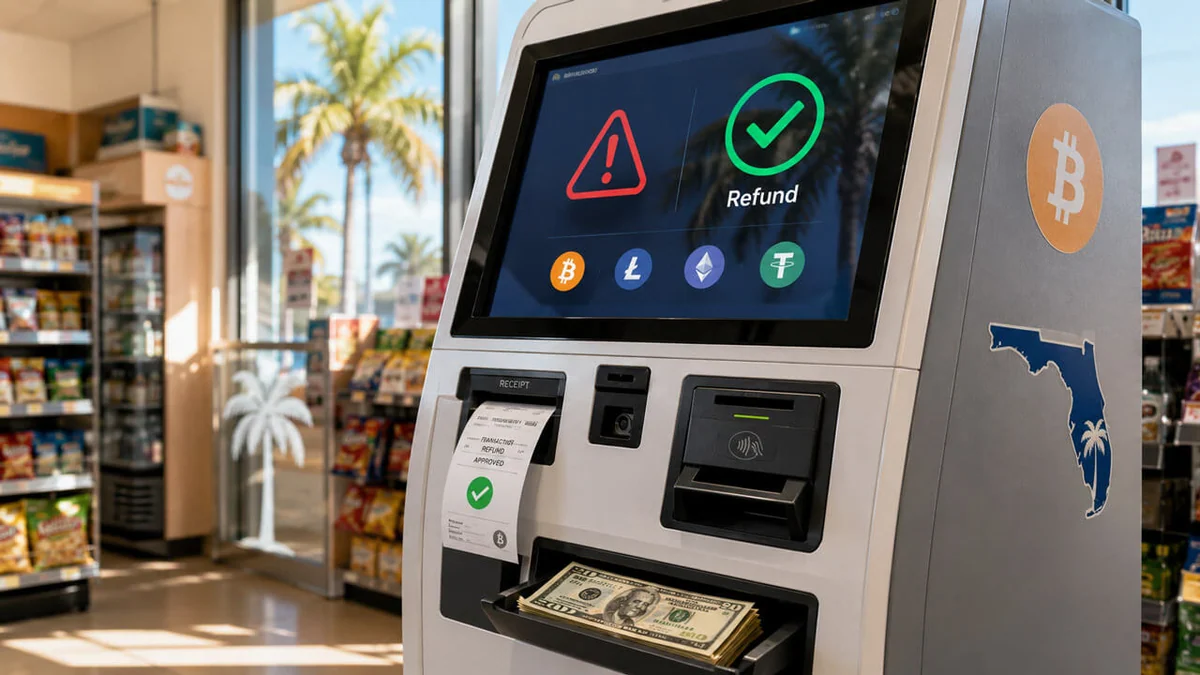
Florida’s new crypto ATM law makes scam refunds the cost of doing business
Florida has turned crypto ATM scam prevention into a business-liability test for kiosk operators. The state’s newly chaptered HB 505, now Chapter 2026-178, creates a virtual currency kiosk framework that will require...
Bitcoin 1 Minute
Here is the latest from the digital-asset markets: Florida has turned crypto ATM scam prevention into a business-liability test for kiosk operators. The state’s newly chaptered HB 505, now Chapter 2026-178, creates a virtual currency kiosk framework that will require fraud warnings, receipts, daily transaction caps, registration filings, and a conditional refund right for fraud victims. Most of the act takes effect Jan.
1, 2027, while the section requiring virtual currency kiosk businesses to register before operating starts March 1, 2027. That staged rollout gives operators time to prepare while setting a clear enforcement path for regulators. Florida is assigning kiosk businesses specific duties before, during, and after a transaction.
Market Dynamics
The most consequential piece is the refund provision. Once the relevant provisions take effect, a kiosk business must issue a full refund within 72 hours for a customer’s first virtual currency kiosk transaction if the customer reports the alleged fraud to the business and to law enforcement or a governmental agency within 60 days and provides proof, such as a police report or notarized affidavit. The result is a state-level test of whether crypto ATM fraud controls can be built into the economics of the kiosk business itself.
Related Reading Bitcoin ATMs were crypto’s street-corner bank. Now regulators are shutting the door Crypto’s first real-world retail infrastructure is breaking down under the weight of scam complaints, legal pressure and the growing normalization of regulated Bitcoin investing. May 30, 2026 Andjela Radmilac Fraud controls become operating rules Florida’s Office of Financial Regulation had already described the gap that HB 505 now addresses.
In a December 2024 statute review, OFR said Florida had 26 known virtual currency kiosk providers, only nine of which were licensed as money transmitters. It also said peer-to-peer, two-party kiosk operators were not required to hold a Florida money-transmitter license unless they acted as intermediaries. That distinction created a practical regulatory problem.
Market Impact
Some kiosk operators could sit outside ordinary money-transmitter licensing while still offering machines that turn cash into irreversible crypto transfers. OFR pointed to consumer notifications as one prevention tool, including US Secret Service warning signs posted around hundreds of Central Florida kiosks. It then raised the possibility that kiosk operators themselves could be required by law to post disclosures even when their activity did not require a money-transmitter license.
HB 505 takes that logic further. It links the warning to transaction caps, receipts, registration information, compliance records, and refund documentation, all of which can be checked later. The law’s structure turns several consumer-protection ideas into operating requirements.
Operators will need to manage the customer experience before the transaction begins, keep records after it ends, and document compliance for renewal or inactive-registration scenarios. Daily caps $2,000 per day for new customers and $10,000 per day for existing customers, across one or more transactions or kiosks General effective date Jan. 1, 2027 Limits how much a scammer can push through one customer in a day Fraud warning and same-day question Kiosk must ask about same-day transactions at other kiosks and display a conspicuous warning before the transaction begins General effective date Jan.
Crypto markets are watching this development closely as investors weigh its potential impact on prices.