Bitcoin faces new tariff risk as EU races to finalize US trade deal this month
The European Union is racing against a self-imposed deadline to implement its side of the existing US-EU trade accord, with the next formal trilogue round set for May 19 in Strasbourg. President Donald Trump threatened...
Bitcoin 1 Minute
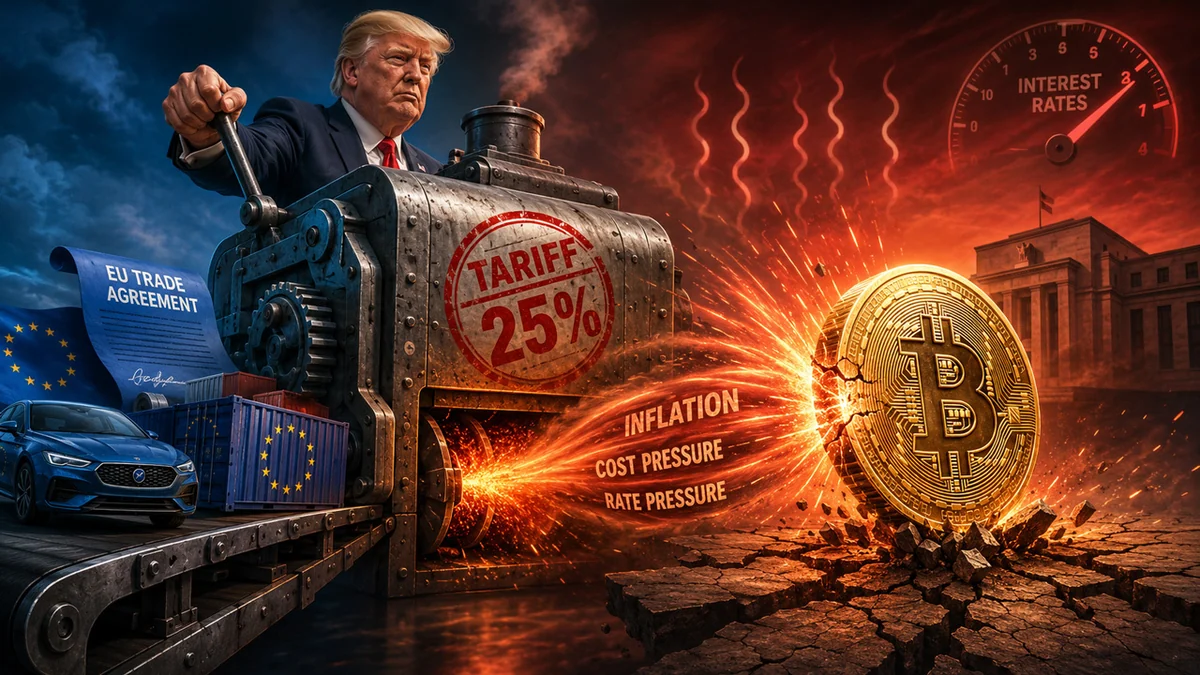
A notable development has hit the crypto markets. The European Union is racing against a self-imposed deadline to implement its side of the existing US-EU trade accord, with the next formal trilogue round set for May 19 in Strasbourg. President Donald Trump threatened on May 2 to lift tariffs on EU cars and trucks to 25% from 15%, a move the Kiel Institute for the World Economy estimates could cost Germany nearly €15 billion in near-term output. Bitcoin's exposure to this trade fight runs through US inflation, Federal Reserve policy, and cross-asset risk appetite.
The European Parliament advanced the implementing legislation on Mar. 26, subject to a sunrise clause tying EU tariff cuts to US compliance, a sunset clause ending concessions on Mar. 31, 2028, and a suspension mechanism if Washington breaches the deal or if US imports surge.
Market Dynamics
Some EU governments have resisted those conditions as too restrictive, preferring faster implementation with fewer safeguards. Parliament's chief trade negotiator Bernd Lange said on May 7 that there is “still some way to go. ” The deal would remove duties on US industrial goods and open preferential access for some American farm and seafood exports, while the EU side would receive capped tariffs of 15% on qualifying goods, a rate Trump now threatens to replace with 25% on autos.
26 European Parliament advances implementing legislation with sunrise, sunset, and suspension safeguards Shows the deal is moving, but with political conditions attached May 2 Trump threatens to raise EU auto tariffs to 25% from 15% Turns the trade story into a live inflation and risk-off threat May 7 Bernd Lange says there is “still some way to go” Signals the deal is progressing, but not done May 19 Next formal trilogue round in Strasbourg Main negotiation deadline for near-term market expectations May 28 Next U. PCE inflation release Key test of whether tariff fears are feeding back into Fed expectations The macro bridge to Bitcoin A Federal Reserve Board note from Apr. 8 estimated that tariffs implemented through November 2025 raised core goods PCE prices by 3.
1% through February 2026 and lifted core PCE overall by 0. Dallas Fed research published May 5 corroborated that figure using a different methodology, estimating that tariff collections raised 12-month core PCE inflation in March 2026 by approximately 0. The results implied that core inflation, excluding tariff effects, would have been around 2.
Market Impact
Headline PCE for March 2026 stood at 3. Those numbers show that the 2025 tariff wave added measurably to core inflation, even as the Fed held rates at 3. 29 and described inflation as still elevated.
San Francisco Fed research found that a 10% tariff increase can initially compress demand enough to lower headline inflation before goods inflation peaks roughly 1. 2% points higher in year two, and services inflation follows about 0. 6% points higher in year three.
A bar chart shows Fed and BEA data estimating that tariffs boosted core goods PCE by 3. 1% and core PCE by 0. 8 percentage points through February 2026.
Crypto markets are watching this development closely as investors weigh its potential impact on prices.