Tether launches decentralized local AI using Isaac Asimov’s Psychohistory straight out of Foundation
Tether’s second reserve asset is intelligence Tether’s new QVAC project begins with an unusual phrase for a stablecoin company. The company describes “QVAC Psy” as a family of foundational models “rooted in the...
Bitcoin 1 Minute
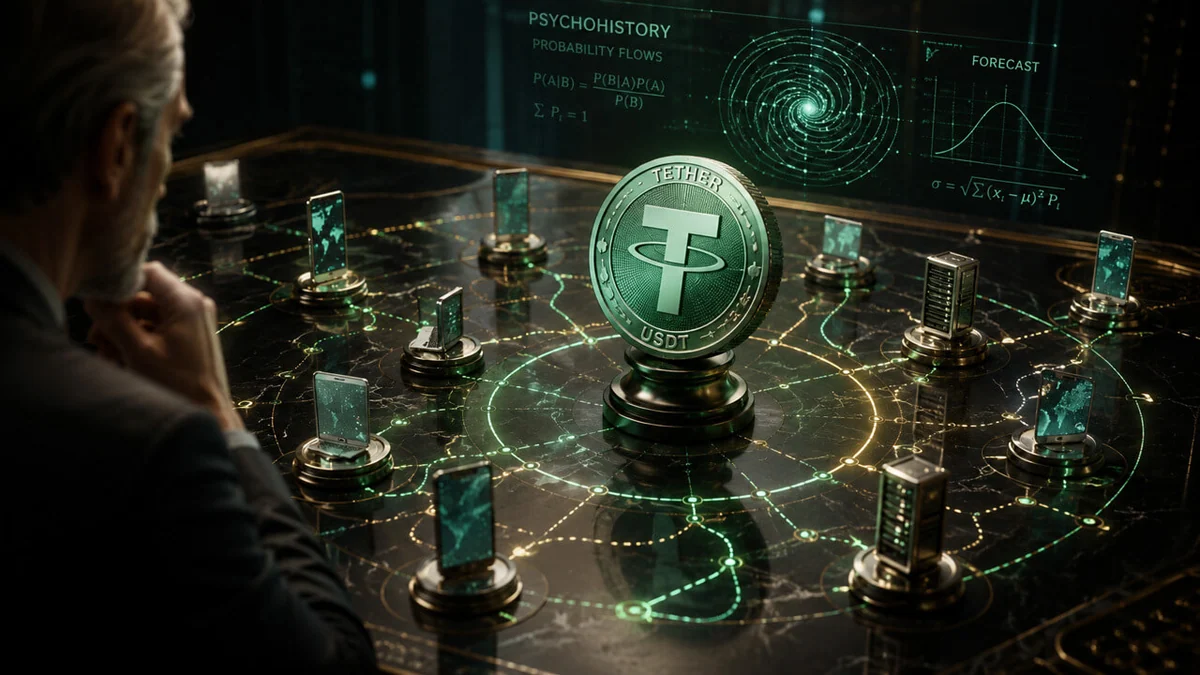
A notable development has hit the crypto markets. Tether’s second reserve asset is intelligence Tether’s new QVAC project begins with an unusual phrase for a stablecoin company. The company describes “QVAC Psy” as a family of foundational models “rooted in the principles of Psychohistory. ” The reference to psychohistory belongs to Isaac Asimov’s Foundation universe, where Hari Seldon uses mathematics, statistics, and social dynamics to forecast the behavior of very large populations and shorten the dark age after the Galactic Empire’s collapse.
The Encyclopedia of Science Fiction describes Asimovian psychohistory as an “Imaginary Science,” while Seldon’s work is a plan that predicts future events and preserves knowledge through systemic breakdown. Tether’s wording functions as a mission statement wrapped in science-fiction language. The company built the largest stablecoin in crypto by turning reserves, liquidity, and distribution into a monetary infrastructure.
Market Dynamics
QVAC applies the same instinct to intelligence. Tether’s first reserve asset remains the dollar-like liability at the center of USDt. Its second reserve asset is becoming compute, models, datasets, and the ability to run AI outside centralized clouds.
From dollar reserves to intelligence reserves Tether’s expansion into AI follows the mechanics of its core business. USDt converts demand for offshore dollars into a reserve stack dominated by short-duration sovereign instruments. In its Q1 2026 attestation update, Tether reported $1.
04 billion in net profit, an $8. 23 billion reserve buffer, roughly $183 billion in token-related liabilities, and about $141 billion in direct and indirect exposure to U. That reserve base gives Tether recurring income, balance-sheet capacity, and room to fund long-duration infrastructure bets from operating strength.
Market Impact
has already tracked how this reserve engine can turn stablecoin scale into strategic allocation. In January, Tether’s 8,888 BTC purchase showed how interest income and operating profits can translate into recurring Bitcoin demand. QVAC pushes the same logic into a different asset class.
Alongside Bitcoin, gold, startups, energy, mining, communications, and other infrastructure positions, Tether is allocating into intelligence itself. The move extends the company’s self-image from issuer of private dollar liquidity to builder of private digital infrastructure. The “psychohistory” language fits that direction because Tether is framing AI as a civilizational layer rather than a software vertical.
QVAC’s public materials describe an “Infinite Stable Intelligence Platform,” a local-first system for the “decentralized mind,” and an answer to centralized AI. The QVAC vision page argues that routing every thought through centralized servers is too slow, fragile, and controlled, and then places QVAC as an edge-native foundation for the intelligence that users possess. That framing mirrors Tether’s broader stablecoin pitch.
Crypto markets are watching this development closely as investors weigh its potential impact on prices.