
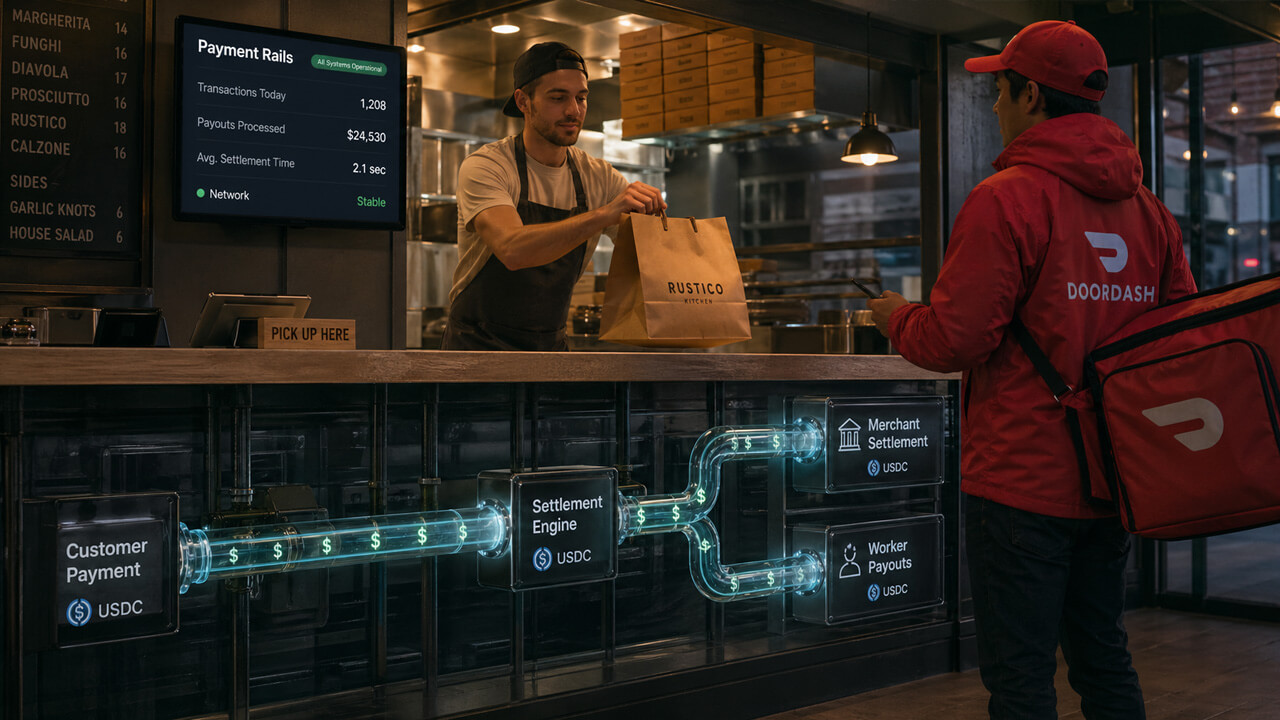
DoorDash is turning stablecoins into its core labor infrastructure across 40+ countries
DoorDash is working with Stripe-backed Tempo to bring stablecoin-powered payouts into its marketplace. The company operates across more than 40 countries, and the money inside that marketplace moves in several...
Bitcoin 1 Minute
Blockchain ekosistemine dair önemli bir haber gündeme geldi. DoorDash is working with Stripe-backed Tempo to bring stablecoin-powered payouts into its marketplace. The company operates across more than 40 countries, and the money inside that marketplace moves in several directions at once, with customers paying at checkout, merchants waiting for settlement, and Dashers depending on payouts that determine how quickly earnings become usable cash. This kind of deep involvement is one of the clearest signs we've had that stablecoins are moving deeper into operating infrastructure.
The most important question stablecoins are faced with now is whether large platforms now see them as a practical way to move money through the parts of their business where settlement speed, foreign exchange friction, and payout reliability affect workers and merchants every day. Tempo said that DoorDash, Stripe , Coastal Bank, and ARQ will all introduce stablecoin payments. DoorDash co-founder Andy Fang said the appeal lies in making payouts faster and more affordable, which fits the operational problem the company is trying to solve.
Piyasa Dinamikleri
Delivery marketplaces compress ordering into a few taps for the customer, but the money behind the order still moves through a slower and more fragmented system built around banking cutoffs, regional rails, and settlement delays that can stretch from hours into days depending on jurisdiction and method. That gap is the biggest problem in DoorDash's model because the users who feel payment friction most directly are rarely the ones thinking about crypto. Merchants feel it in working capital, since slower settlement affects payroll, inventory purchases, and short-term liquidity planning.
Dashers feel it in immediate cash availability, especially during periods of rising fuel or living costs. DoorDash itself addressed that pressure last month when it announced gas relief measures for US Dashers and a parallel support program for Canadian Dashers. For crypto, that shift in use case matters more than another round of corporate claims about innovation.
Crypto’s strongest path into the mainstream has always depended on a function that works better than the alternatives. For Bitcoin , those functions are reserves, macro positioning, and the institutional wrapper built around spot ETFs. And for stablecoins, it's starting to look like settlement infrastructure for internet-native commerce.
Piyasalara Etkisi
The payout problem is where stablecoins actually start to feel useful Payout systems involve several bottlenecks at once. A global marketplace has to reconcile local currencies, compliance requirements, banking partners, timing windows, and the different financial needs of merchants and workers. Even when the customer side of the transaction feels instant, the backend often remains bound to slower systems with layered intermediaries.
That structure creates costs that seem minor on a single transaction but are huge at scale, especially for a company handling large volumes across borders. Stripe has been laying out this case in unusually explicit terms through recent explainers on stablecoin payments , payout strategies , and the broader forces behind their growth. Across those materials, the same pattern keeps appearing: businesses care about stablecoins when they reduce delays, lower costs, expand reach, and improve predictability in cross-border transfers and treasury movement.
Tempo itself was introduced last year as a payments-focused blockchain built by Stripe and Paradigm, with a partner list that already included DoorDash alongside companies such as Deutsche Bank , Shopify , OpenAI , Revolut , and Visa . The design choices around high throughput, sub-second finality, and stablecoin-native fees pointed toward a specific thesis from the start. The builders behind these networks were targeting payment flows that existing chains struggled to serve cleanly at enterprise scale.
Blockchain ekosistemindeki bu gelişme, dijital varlık piyasalarını şekillendirmeye devam ediyor. Uzmanlar, konunun yakın vadeli etkilerini mercek altına alıyor.